

Pure Acrylic Vs Styrene Acrylic Emulsion Uae
Pure Acrylic Vs Styrene Acrylic Emulsion Uae
Choosing the right binder is one of the most important decisions in water-based paint formulation. Pure acrylic emulsion and styrene acrylic emulsion are both widely considered for architectural and industrial coating systems, but they are not interchangeable in every formulation.
For UAE paint manufacturers, the decision often comes down to more than the initial raw-material price. Climate exposure, required durability, application, formulation objectives, and overall cost-in-use all need to be considered.
So, which is the better choice for your UAE paint formulation? The answer depends on the performance level and economics you need from the finished coating.
What Is Pure Acrylic Emulsion?
Pure acrylic emulsion is a water-based polymer dispersion used as a binder in paints and coatings. It is formulated to provide a combination of film formation, adhesion, durability, and resistance properties required by different coating systems.
Pure acrylic emulsions are often considered when a formulation requires stronger overall performance, particularly for applications exposed to demanding outdoor conditions.
However, the actual performance depends on the specific polymer grade and the complete paint formulation. Pigments, additives, fillers, coalescents, rheology modifiers, and manufacturing conditions can all influence the final coating.
For manufacturers sourcing from pure acrylic emulsion manufacturers, reviewing the product's technical data sheet is therefore essential before selecting a grade.
Also Read - What are water based coatings emulsion?
What Is Styrene Acrylic Emulsion?
Styrene acrylic emulsion is a water-based styrene acrylic copolymer emulsion in which acrylic and styrene components are combined within the polymer system.
It is widely considered for water-based paints where manufacturers want to balance coating performance with formulation economics. Depending on the grade, styrene acrylic emulsions can provide useful adhesion, film formation, water resistance, and durability characteristics.
This makes styrene acrylic paint systems suitable for a variety of architectural and general-purpose coating applications.
As with pure acrylic, performance varies between grades. The right selection should be based on the required properties of the finished paint rather than simply the polymer name.
Pure Acrylic vs. Styrene Acrylic: Key Differences
The biggest difference is polymer composition and the performance profile that a particular grade is designed to deliver.
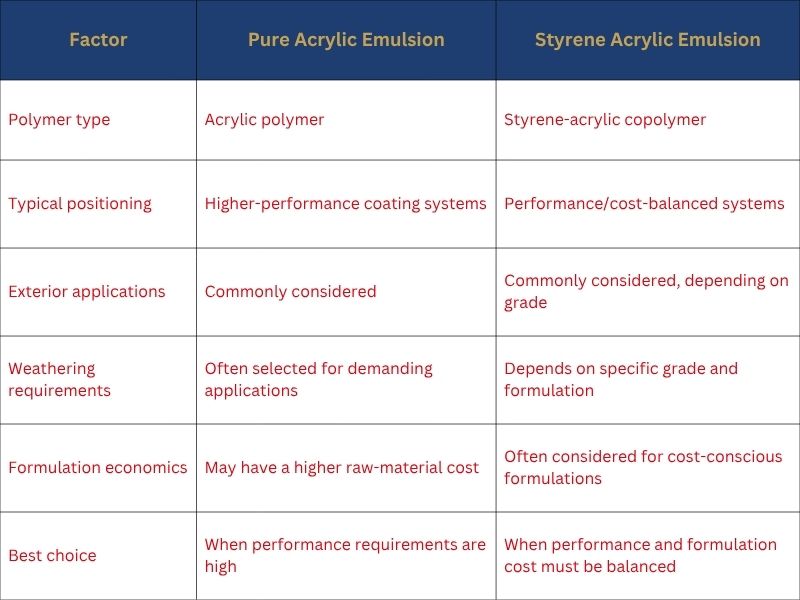
This table is a general formulation guide. The TDS of the specific emulsion should always be used to confirm suitability.
Styrene Acrylic Emulsion - View Technical Data Sheet
Pure Acrylic Emulsion - View Technical Data Sheet
Performance Comparison for UAE Paint Formulations
The UAE presents specific challenges for exterior coatings. High temperatures, strong sunlight, and demanding outdoor exposure mean that binder selection should be made carefully.
For premium exterior applications, a suitable pure acrylic emulsion UAE formulation may be considered when durability and weathering performance are important priorities.
For projects where the manufacturer needs to balance performance with formulation economics, a suitable styrene acrylic emulsion UAE grade may provide a practical alternative.
The important point is that neither polymer should automatically be considered “better.” The correct choice depends on the required service life, application, substrate, pigment package, and target formulation cost.
Which Is More Cost-Effective: Pure Acrylic or Styrene Acrylic?
When comparing pure acrylic and styrene acrylic, looking only at the purchase price per kilogram can be misleading.
A better approach is to calculate cost-in-use. This considers factors such as:
- Polymer price
- Recommended dosage
- Required coating performance
- Formulation solids
- Pigment and filler loading
- Additive requirements
- Processing conditions
- Expected performance of the finished coating
A styrene acrylic system may be attractive when the formulation requires a practical balance between performance and cost. Pure acrylic may make more sense where higher performance justifies the additional binder investment.
Therefore, the most economical option is not necessarily the polymer with the lowest purchase price.
Applications of Pure Acrylic Emulsion
Pure acrylic emulsions can be considered for applications where the coating requires a higher level of performance.
Typical applications may include:
- Exterior architectural paints
- Premium decorative coatings
- Protective coating systems
- Weather-resistant water-based coatings
- Applications requiring good adhesion and durability
The appropriate grade should be selected according to the substrate and performance specifications of the finished product.
Applications of Styrene Acrylic Emulsion
Styrene acrylic emulsions are commonly used in water-based coating systems where manufacturers need a combination of performance and formulation efficiency.
Applications can include:
- Interior and exterior architectural paints
- Decorative paints
- General-purpose water-based coatings
- Wall coatings
- Construction-related coating systems
- Cost-conscious paint formulations
Again, the exact suitability depends on the individual styrene acrylic copolymer emulsion grade and the complete formulation.
Also Read - Styrene Acrylic Emulsion Suppliers in UAE Guide
Why UAE Climate Conditions Matter When Selecting an Emulsion
Paint manufacturers in Dubai, Abu Dhabi, Sharjah, Ajman, and other UAE markets need to consider the conditions in which their coatings will be used.
Exterior coatings can experience intense sunlight, elevated temperatures, and varying humidity. These factors can place additional demands on the binder and finished paint film.
When selecting an acrylic emulsion, manufacturers should therefore consider:
Exterior exposure: Will the coating be exposed to direct sunlight and weather?
Durability requirements: How long is the coating expected to maintain its appearance and performance?
Substrate: Is the paint intended for concrete, plaster, masonry, or another surface?
Application: Will it be applied by brush, roller, or spray?
Budget: What is the acceptable formulation cost without compromising the required performance?
These questions help narrow the choice between pure acrylic and styrene acrylic.
How to Choose the Right Acrylic Emulsion for Your Formulation
Before purchasing from an acrylic emulsion supplier in UAE, manufacturers should request the relevant technical documentation and evaluate the product against their formulation requirements.
Check:
- Solids content and viscosity
- pH and other relevant specifications
- Recommended applications
- Film formation characteristics
- Compatibility with other formulation ingredients
- Storage and handling requirements
- TDS and SDS documentation
- Batch-to-batch consistency
Laboratory trials are particularly important. A small-scale formulation test can reveal compatibility and performance issues before the material is introduced into large-scale production.
Why Choose Tulsi Biosciences Pvt. Ltd. for Acrylic Emulsions?
Tulsi Bio Sciences provides water-based emulsion solutions for manufacturers working across paints and coatings applications. For B2B customers, product selection should be based on the technical requirements of the intended formulation rather than simply choosing between “pure acrylic” and “styrene acrylic.”
Manufacturers can discuss their application, required performance, formulation objectives, and commercial requirements with the supplier before final selection.
For current product specifications, buyers should refer to the applicable TDS and SDS and conduct formulation trials before commercial production.
Contact Details :
Get a Quote - Contact us
Manufacturing Hub - Survey No. 409, P1/P1, Taluka, 4th Phase, Phase 3, Karvad, Vapi, Gujarat 396195
Phone Number - +91 99042 22944
Email - sales@tulsibiosciences.com
Conclusion
So, pure acrylic vs. styrene acrylic emulsion—which fits a UAE paint formulation budget?
There is no single answer for every formulation. Pure acrylic emulsion can be considered when higher-performance requirements are a priority, while styrene acrylic emulsion can be a practical option when manufacturers need to balance performance and formulation economics.
For UAE paint manufacturers, the best decision is to compare performance, dosage, compatibility, durability requirements, and total cost-in-use rather than focusing only on the initial emulsion price.
A technically suitable binder, supported by reliable documentation and consistent supply, can help manufacturers develop water-based paints that meet both performance and commercial objectives.
Frequently Asked Questions (FAQ)
What is the difference between pure acrylic and styrene acrylic emulsion?
Pure acrylic is an acrylic polymer emulsion, while styrene acrylic is a copolymer containing acrylic and styrene components. Their performance and formulation economics can differ by grade.
Is pure acrylic better than styrene acrylic?
Not necessarily. Pure acrylic may be preferred for some demanding applications, while styrene acrylic can be suitable where performance and cost need to be balanced. The correct choice depends on the formulation.
Which is more cost-effective, pure acrylic or styrene acrylic?
Styrene acrylic may offer an attractive cost-performance balance, but actual cost-effectiveness depends on price, dosage, formulation requirements, and finished-coating performance.
What is styrene acrylic emulsion used for?
It is used in various water-based paints and coatings, including architectural, decorative, and general-purpose coating systems, depending on the grade.
What should I check before buying acrylic emulsion?
Review the TDS and SDS, technical specifications, recommended applications, compatibility, storage requirements, and performance requirements. Laboratory testing is recommended before commercial production.
Latest Posts


Have questions or need product details?

